Every one of Ries's ten pivot types is a bet. And every bet has a required input — a specific piece of customer evidence you need before the dial is worth turning. Teams in the trough are almost always turning dials they don't have the input for. That is what the flat part of the startup curve is made of.
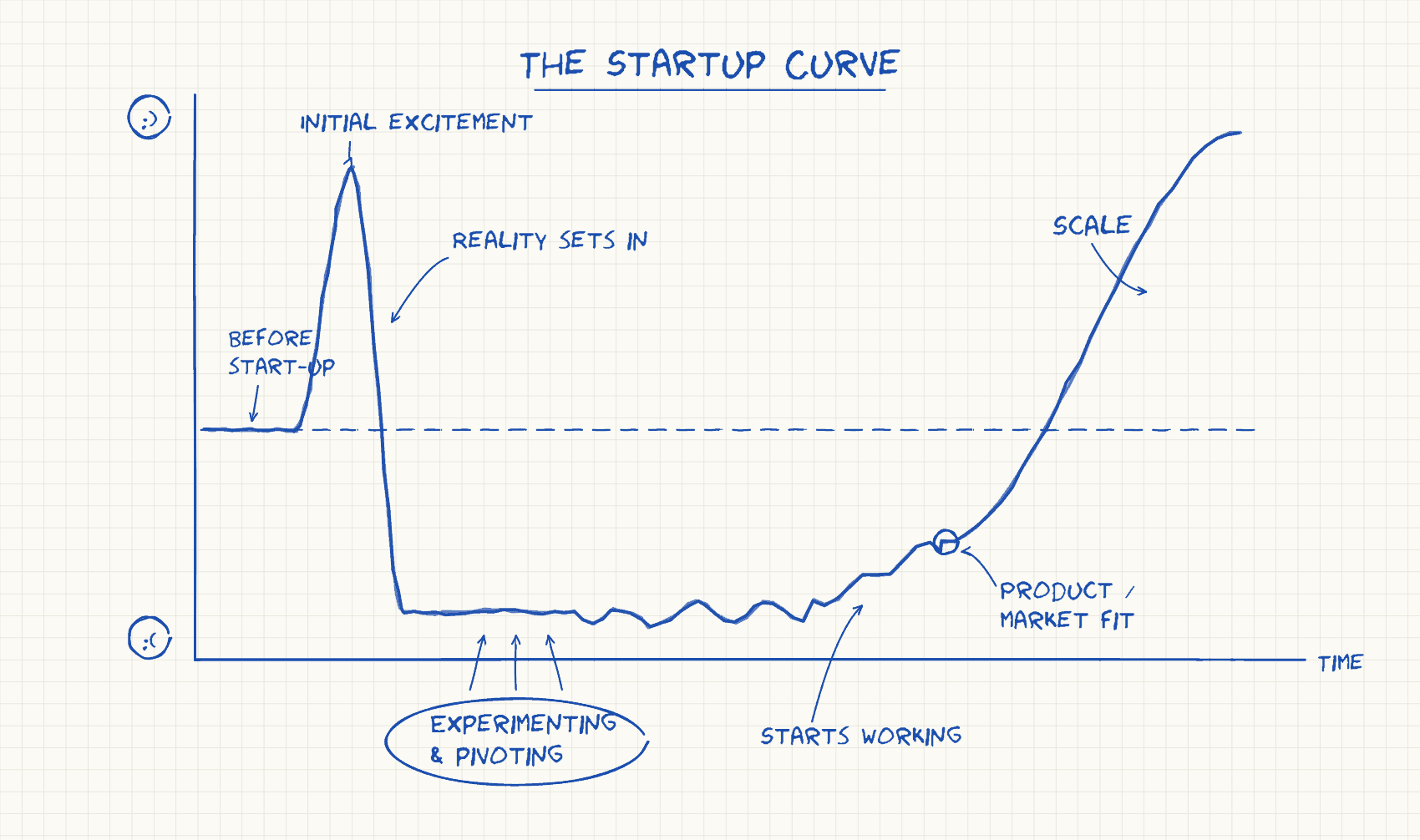
The label on that stretch — experimenting and pivoting — is the most expensive phrase in startup folklore. It describes what teams do down there. It says nothing about what they're looking for.
Pivot
A “structured course correction designed to test a new fundamental hypothesis.” In the Lean Startup methodology, that hypothesis concerns three things: the product, the strategy, and the engine of growth.
Strategy is in there explicitly, so the narrow reading — pivot means change what you're building — is out. But notice what the definition names and what it doesn't. It names the three objects a hypothesis can be about. It never names the class of evidence that settles one. Two of the ten types are customer pivots, so it isn't that Ries forgot the customer — it's that demand appears as a thing you can change rather than a thing you have to measure first. And unmeasured things don't get an owner, an instrument, or a slot on the agenda.
Required input
The evidence without which the result of turning the dial is uninterpretable. Not the evidence that justifies the decision after the fact — the evidence that makes the outcome readable at all. Turn a dial without it and you learn nothing from either result: the win is unattributable, the loss is unexplainable, and the only honest conclusion is try something else.
Ten dials, ten required inputs
| Pivot type / what changes | Required JTBD input |
|---|---|
| Bets on demand — require evidence about who is struggling | |
| Customer segmentSame product, different audience. | The struggling moment and the six forces for the new executor — the person who actually does the job, who may not be the buyer. Evidence they exist in volume, not in one flattering call. Core Jobs interviews→Switching, against their incumbent, not you Kill Struggle is real but no one can name a moment. Same product, new audience, same silence. |
| Customer needSame customer, different problem. | The job in all five dimensions — aspirational, functional, emotional, social, and consumption (how they expect to pay for and live with progress) — plus evidence the original job ranked low against the others. Core Jobs interviews→No-decision Kill The new job ranks higher but nothing was ever hired against it. That's an inconvenience with better language. |
| Demand-adjacent — test the depth or breadth of the job, hold the customer fixed | |
| Zoom-inOne feature becomes the entire product. | Which step of the job that feature serves, and evidence the value concentrates there — what customers actually used versus what they said mattered. Product use interviews→Expansion |
| Zoom-outThe product absorbs more scope. | The job map, and what customers hired alongside you to finish the job — the steps you left them to assemble themselves. Expansion interviews→Core Jobs, for the job map |
| Assume demand is settled — bet on delivery, capture, or growth | |
| PlatformAn application others build on. | The struggling moment and forces for a second executor, the builder. This is a segment bet wearing product clothes. Core Jobs interviews, run on the builder→Switching |
| Business architectureMargin and volume trade places. | Forces and hiring criteria for a different executor at a different price point. Also a segment bet. No-decision interviews→Switching |
| Value captureThe revenue model changes. | Anxiety and avoidance at the hiring moment, and the consumption dimension of the job — how the customer expects to pay for progress. No-decision interviews→Switching |
| Engine of growthSticky, viral, and paid swap places. | Recurrence of the struggling moment, the usage experience, and the social dimension of the job. Firing + Product use for sticky→Core Jobs for viral |
| ChannelThe route to the customer changes. | Where the push is actually encountered — whether the customer is in passive or active looking when your channel reaches them. Switching interviews — the timeline is the channel evidence |
| TechnologySame solution, different technology. | The functional dimension and the hiring criteria: cost, speed, performance. Demand is held constant by definition. Switching interviews→No-decision |
Every entry draws on the same five research objects: the struggling moment · the job in five dimensions (aspirational, functional, emotional, social, consumption) · the six forces (push, pull, desire vs. habit, anxiety, avoidance) · the hiring and firing moment · the product experiences (onboarding, usage). All read along the customer's progress timeline — and all uncovered by segment.
Six instruments produce them: core jobs · switching · no-decision · adoption · expansion · firing. Which one you need is set by the dial — not by who is easiest to reach.
Three things fall out of that column.
Segment isn't a dial. It's the axis. The taxonomy files customer segment as one type among ten, a peer of channel and pricing. It isn't. Every other row's input is segment-conditional — the forces, the criteria, the job dimensions all change when the executor changes. Nine dials, one index. Which is why turning a channel dial before you've settled segment produces a reading you can't interpret.
Some dials are the same bet. Technology and value capture both require the hiring criteria — cost, performance, risk at the moment of choice. A team that runs a technology pivot, then a pricing pivot, has run one experiment twice and logged it as two data points. That's a mechanical way to spend nine months and learn nothing, and it looks exactly like the wiggly line.
Two of the supposedly product-side dials are segment bets. Platform adds a second job executor. Business architecture moves you to a different one at a different price point. Both are usually run as architecture decisions with no new customer evidence at all.
Only two of the ten admit they are asking who is struggling, and how badly.
So why do teams reach past them? Because pricing, channel, and motion can be changed on Monday. Segment and need require going out and finding out — weeks of interviews before anyone can act. The taxonomy is neutral about which dial to turn. The incentives are not.
Two worked cases
Seed · in the trough Wrong dial
Trials, no conversion. The room wants a pricing pivot: lower entry tier, usage-based billing, ship in three weeks.
Check the column first. Value capture runs on anxiety and avoidance at the hiring moment, plus the consumption dimension. Nobody has that evidence, and the column says no-decision interviews — so that's what they run. Twelve conversations with people who evaluated and didn't buy.
What comes back isn't about price. All twelve already had a workaround running, and not one could name a moment — no slipped deadline, no failed audit, nothing that made the status quo intolerable. They took the trial because the demo was good.
That's not an anxiety finding. It's a missing push, so the dial was never value capture. It was segment. The pricing pivot ships on time, moves nothing, costs a quarter.
Series A · post-fit Right dial, wrong direction
Net revenue retention flat at 96%. The room wants a zoom-out: build the reporting layer every account keeps asking for.
Zoom-out needs the job map and what customers hired alongside you. This team has customers, so the instruments the trough withholds are open — twelve expansion interviews, read against the map.
Reporting comes up in all twelve. It also sits at the end of the job, after the decision is made, and nobody has spent a dollar on it — they export to a spreadsheet and it's fine. The costly step is two earlier: every account solved data ingestion with a contractor or a two-week internal project before onboarding started.
Zoom-out was the right dial. The direction was backwards — absorb upstream, not downstream. The requested feature was the loudest one, not the expensive one.
Narrative examples drawn from client engagements across different stages and categories. Details changed, shapes unchanged — both recur.
What the trough will actually give you
There's a second filter on that column, and it's harsher than the incentive one. Four of the six instruments require customers you don't have yet. Product use and expansion need people already inside the product. Firing needs people who left it. A team in the trough has three instruments available — core jobs, switching, no-decision — and every dial those three can't reach is a dial that team has no business turning.
Which produces an uncomfortable pairing with the finding above. The fastest dial requires the hardest interview. Value capture ships in three weeks and runs on no-decision evidence — the one cohort that isn't in your CRM as anything, because they never became a record. Business architecture is the same. The dials that feel cheap to turn are the ones whose inputs cost the most to collect, which is most of the explanation for why they get turned blind.
The trough feels evidence-poor, and that feeling is an artifact of where teams look. The only population that self-identifies is the one that already left — churn announces itself, so firing interviews are strangely available to a company with almost no customers. Latent demand announces nothing. People with the struggle aren't shopping, aren't searching your category, and won't pass a screener written in your vocabulary. They're not scarce. They're unaddressed.
That population is reachable by exactly the three instruments you have, and it carries one hard limit worth stating plainly: latent-stage evidence sizes struggle and nothing else. Someone who hasn't started looking cannot tell you their hiring criteria, their price sensitivity, or the trade-offs they'd make — those don't exist until a decision is underway. So latent evidence supports the two demand bets and no others. Value capture, technology, and channel all need someone who has been in a decision.
Which lands the same claim from the other direction. It isn't only that eight of the ten dials assume demand is settled. It's that two of the ten are the only ones a pre-fit team can gather the evidence for at all.
And there's a sting in which two. No-decision, product use, expansion and firing run on bounded protocols — you know the questions before you walk in, so volume is mostly a budget problem. Core jobs and switching don't work that way. Both depend on chasing a timeline nobody has heard before, where the useful question is the one the last answer just created. The instruments that scale cheaply are the four you can't use yet. The two you need are the two that resist scaling.
The one input you can't manufacture
Look down the required-input column and one item keeps recurring: the push of the customer's situation. It's the only force you cannot create.
People don't adopt products. They fire something and hire something else, and that trade happens only when push, pull, and desire outweigh habit, anxiety, and avoidance. Two of those six get almost all the attention, and it's the wrong two.
Pull — the lever you control
Better demo. Cleaner onboarding. Sharper positioning. More integrations. It's buildable, it's visible, and it ships on your schedule — which is why teams who like building things reach for it first.
It doesn't help that product/market fit gets read as a pull metric — what people pull into their lives. Make pull the measure, and pull is what gets worked on.
Can't start anything on its own.
Push — the lever you can only find
A deadline that slipped. A hire that quit. An audit that failed. A spreadsheet that finally broke.
Push is manufactured by the customer's situation, not by your roadmap. You can go find it, or position yourself to be present when it recurs. You cannot create it — and no amount of building substitutes for it.
The one input you can't fake.
The ordering matters more than any ranking. Pull without push produces interest that decays — people like it, nobody moves. Push without pull sends people out looking, and they'll hire something clumsy to get the job done. Pull can sharpen a switch that's already underway. It can't originate one.
But read the word. Fit names a relation, not a property — what you built fitting into a context that already exists: the situation, the workaround already running, the forces already in play. Pull is what you add to the product. Fit is whether the customer's context has a socket for it.
And that context is exactly where the two backward forces live. Habit and anxiety are fixed costs of switching, set by the customer's situation rather than your feature set — which means they don't shrink as your product improves. So there's a threshold: if the struggle isn't larger than the friction of changing, no amount of product, pricing, or channel work crosses it. You're not underbuilt. You're under-demanded.
The good news: struggle is detectable before you commit to a dial, because it leaves fingerprints. People in real pain already did something about it — a spreadsheet with eleven tabs, a contractor every Thursday, two tools duct-taped together, budget on a line item that half-solves it. At the latent stage, no workaround means no demand. It's the only signal available before search behavior starts — and someone who describes the problem eloquently but has never spent a dollar, an hour, or a headcount against it is describing an inconvenience. (A genuinely new category can fail this test honestly. If you think you're in one, you are making a much larger bet than a pivot, and this article is the wrong tool.)
Which gives you three questions worth more than any roadmap debate:
- Was there a moment — a specific trigger when this stopped being tolerable?
- What did they already hire to deal with it, and what is that costing them now?
- What happens if they do nothing for two more quarters? If the answer is "not much," stop here.
Before you turn the dial
All of which reduces to a sequence you can run in a room in ten minutes, before anyone opens the roadmap.
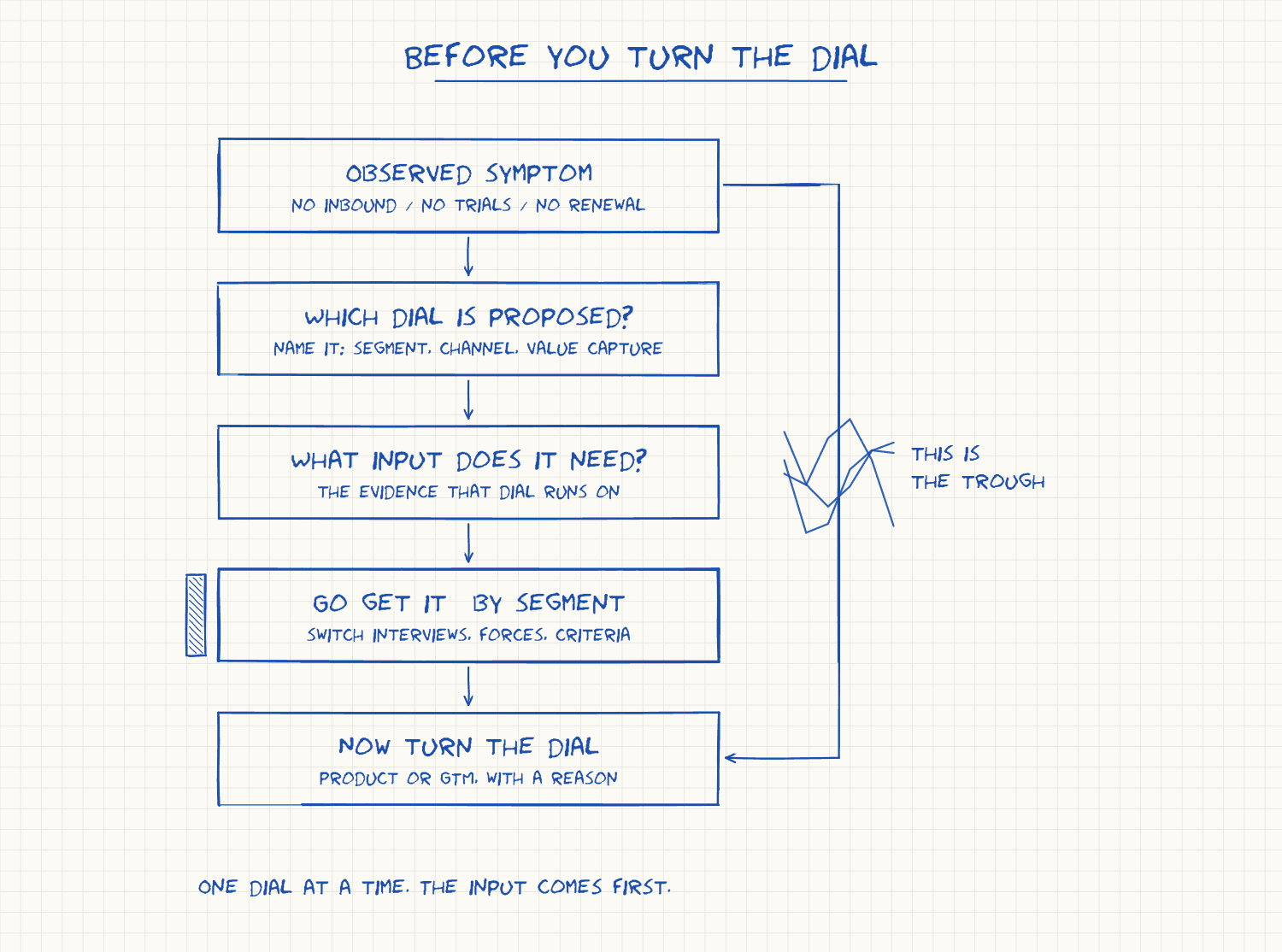
The scribbled-out shortcut is the one almost everyone takes: name a symptom, change something, watch. It's fast, it feels like progress, and it is precisely the wiggly line in the first sketch.
Run the sequence on your own pivot
The Should We Pivot? diagnostic walks this order for the dial your team is proposing: the symptom, the dial, the input it needs, and whether you hold it. It shows which inputs are observed, which are still assumptions, and the interview that would fill the gap. Two of the worked examples are the cases above.
The curve inflects when a team finds a struggle large enough to overcome the cost of switching, in a population big enough to matter, at a stage of demand they know how to reach. Everything before that is search. Everything after is execution.
The trough isn't the cost of building the wrong thing. It's the cost of turning dials you don't have the inputs for.