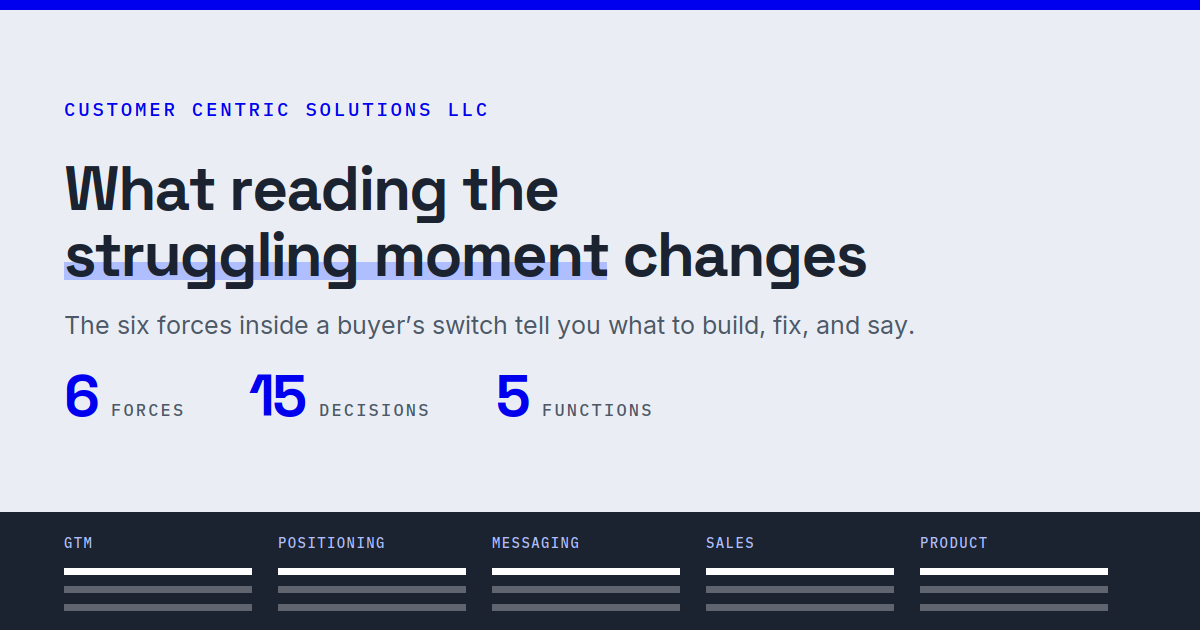
What Reading the Struggling Moment Changes
Most switching research stops at the finding. Forces get named, nobody assigns them to a decision, and the positioning is unchanged three weeks later. Fifteen decisions across GTM, positioning, messaging, sales and product, each tied to the force that governs it — plus which force is widest, which one vanishes after messaging, and why one readout lands differently with four different teams.
Open the grid →
No Single Moat Is Durable. Stack Them.
Buffett found one moat and held it. Helmer turned moats into a taxonomy. Rajaram argues that in the AI era no single one is sufficient. The eight moats with the failure mode and evidence behind each, the five loops that make them compound, and six stacks that actually hold — with a free diagnostic on your own business at the end.
Read the field guide →
Business Loop Diagnostic — See What It Produces
Moats are the category of advantage. Loops are the mechanism by which advantage compounds — and without one underneath, a moat is a snapshot rather than a trajectory. The diagnostic run end to end: the curve test, the two stocks that both have to be real, the 6-cell matrix, and the three ways a working loop dies. Worked on a partnership the market read as a growth engine.
See the diagnostic →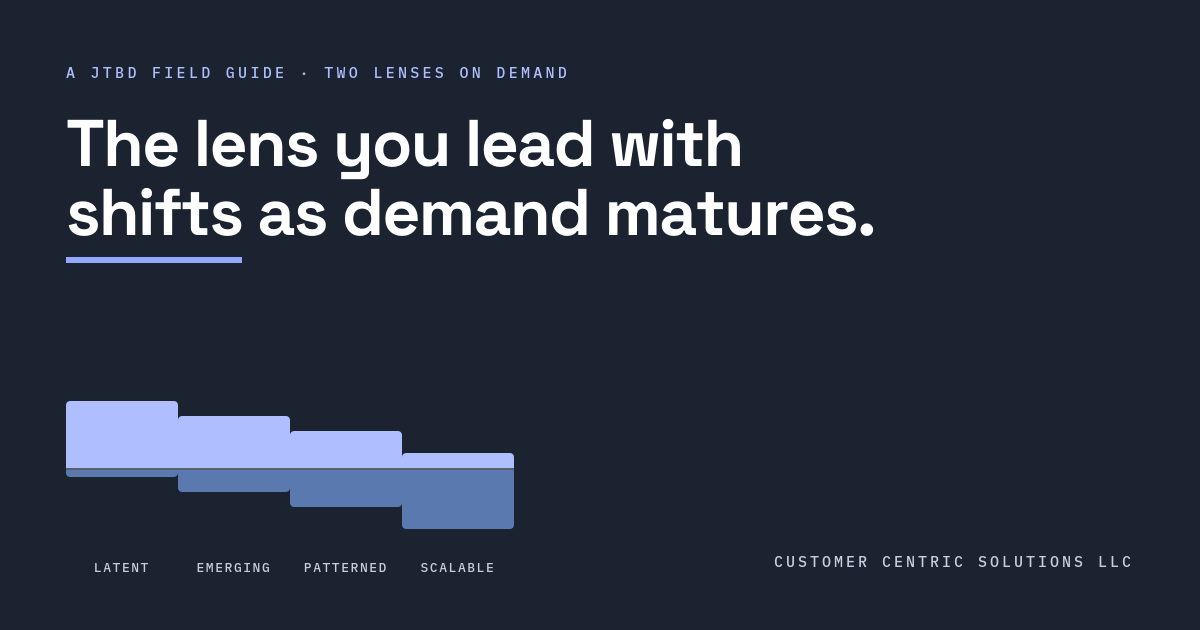
JTBD Methods Across the Four Stages of Demand
Jobs-to-Be-Done has two lenses. Progress (qualitative) leads early, when you're finding the struggle. Process (quantitative) leads late, when you're sizing and scaling it. A stage-by-stage guide to which lens to lead with, how to tell which stage you're in, and how to get the handoff right.
Read the field guide →